
Records Reveal CoreWeave Wrote the Script for Kenilworth's Data Center Defense
A twelve-day paper trail and the months that followed show Kenilworth's public defense of a CoreWeave data center, moving from a company-scripted TV interview to a company-funded lobbying campaign.
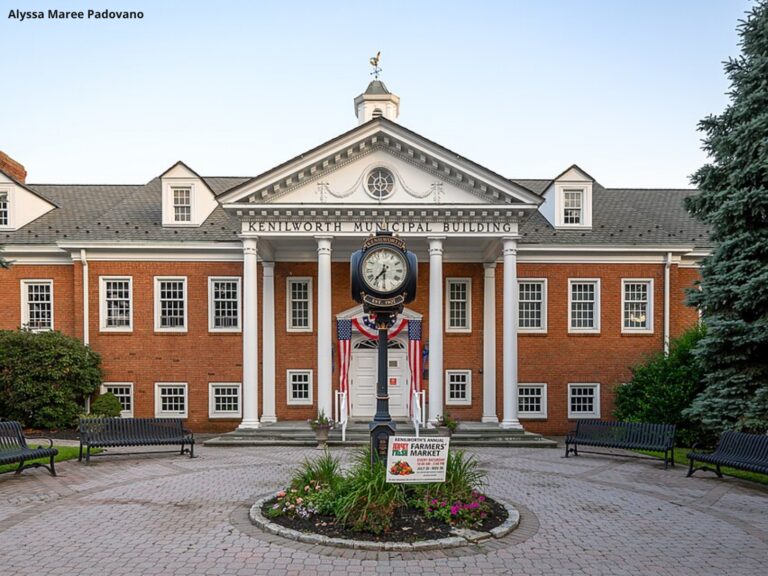
The Kenilworth Municipal Building in Kenilworth, N.J., Borough officials fielded growing public opposition to a CoreWeave data center project at meetings held here throughout 2026. (Credit: Alyssa Maree Padovano)
Editor’s note: The Central Jerseyan is free to read and supported by advertising. If you value this kind of local reporting and want to help sustain it, you can become a citizen supporter on Patreon. Your contribution helps fund continued coverage of local government, schools, and community issues.
Chris Howell | July 16, 2026
As Kenilworth Mayor Linda Karlovitch spoke with a local reporter over the phone, she was asked about growing public backlash against the planned construction of a $1.8 billion data center project at the former Merck campus in town. The project includes multiple data centers, with one now under construction, all owned and operated by CoreWeave, a company that leases data-center computing power to other businesses building AI products.
“When Merck left, it left a real gap in jobs, in tax revenue, and CoreWeave is filling that gap to build something for the future,” she told News 12. She also gave assurances that the project would not strain the local water supply or electrical grid.
Now, internal records show those words were not the Mayor’s own. Rather, they were talking points delivered by an attorney working for CoreWeave.
The records, obtained by The Central Jerseyan through public records requests, show the mayor’s local news interview was the opening move of a public relations campaign carried out by the mayor and the borough’s outside counsel, both acting on guidance from attorneys and staff employed by CoreWeave. The campaign evolved as opposition to the company’s data center footprint grew.
DON’T LET AN ALGORITHM DECIDE YOUR NEWS
Sign up for The Central Jerseyan Newsletter for independent local news and events every weekend.
The effort began with an email. On April 18, Jeffrey Gradone, an attorney at Archer & Greiner, CoreWeave’s law firm, emailed Kenilworth’s outside redevelopment counsel, Michael Ash, a document titled “Talking Points — Mayor Linda Karlovitch, CoreWeave Kenilworth | Local TV.”
It was a full script, complete with an opening line, three “core messages,” and prewritten answers under headings like “If Asked About Electricity or Water.” It even contained a closing line.
“I want Kenilworth residents to feel proud of this project — not just what it means for our tax base, but what it says about who we are as a community,” the line reads.
Ash forwarded it to the Mayor within the hour and wrote, “Call me once you have a chance to review.” The email also included the cellphone number of a senior CoreWeave official whom the mayor could reach directly with questions.
Set against Karlovitch’s News 12 interview, the match is almost exact.
The script promised, “load studies to ensure CoreWeave won’t impact the local grid.” Karlovitch said the same load studies would “ensure Coreweave won’t impact the local grid.”
The script said the cooling system “avoids continuous use of local water.” Karlovitch said it “avoids continuous use of local water.”
The script read, “This is the former Merck global headquarters. When Merck left, it left a real gap — in jobs, in tax revenue, in community pride. CoreWeave is filling that gap.” Karlovitch said, “When Merck left, it left a real gap in jobs, in tax revenue, and CoreWeave is filling that gap.” Only “community pride” was dropped.
Karlovitch, Ash, and Gradone did not respond to requests for comment about the script.

Kenilworth Mayor Linda Karlovitch. Records obtained by The Central Jerseyan show her public comments defending the CoreWeave data center project were scripted by the company’s own lawyer. (Credit: Borough of Kenilworth)
The same document also states that CoreWeave pledges to create 143 jobs, which officials repeated into the summer as public meetings grew longer and louder.
Victor Gomes, vice president of the Union County Residents Alliance Coalition, or UCRAC, said a Change.org petition urging Kenilworth to block the planned data centers has more than 12,000 signatures. UCRAC was formed to oppose the construction of data centers within the county.
As public interest in the data centers grew, Karlovitch turned to CoreWeave for more material. Texts between April 23 and 25 show her asking the company’s director of community partnerships, Rebecca Darling, about sound-level figures. Darling supplied a range of 42 to 49 decibels, against a 50-decibel limit, plus a scripted closing line and guidance on fielding questions about the project from neighboring towns. CoreWeave did not say where those figures came from.
The pressure only grew from there. On April 28, the Kenilworth Planning Board took up CoreWeave’s request to subdivide the data-center lot into four new parcels. The board’s meeting minutes record 95 emails of opposition on file. Roughly forty residents spoke from Kenilworth and nine surrounding towns. It was the largest opposition turnout the project had yet drawn.
One resident asked whether the Council was “beholden to an NDA with Coreweave.” The board’s attorney deflected. “That is a question for the Borough Council,” the attorney said.
An internal email from June 2025 shows Ash telling colleagues, with the Mayor copied, “we all signed the NDA!!”
Two days after the contentious planning board meeting, the borough counsel forwarded the mayor a proposal from CLB Partners, a Trenton government-relations firm. The proposal called for a $10,000-a-month retainer to address “falsehoods” about the project. Ash wrote that it would be paid “through the professional escrow.”
That escrow, records show, had been set up months earlier. It was intended to pay standard redevelopment professionals, including outside counsel, planners, and an engineer. No public relations or lobbying firm appears on the original list.
CoreWeave, through a spokesperson, said it is “transparent with municipal officials” and committed to “open dialogue and responsible partnership with the Kenilworth community,” but did not address whether it is funding CLB Partners or MAD Global through the escrow. Jonathan Boguchwal of CLB Partners did not respond to requests for comment.
At a May 6 meeting, officials distributed talking points headed “Advisory Information from Borough Attorney.” Mark Semeraro confirmed he is Kenilworth’s borough attorney but declined to say whether he wrote that specific memo, citing attorney-client privilege. Officials at the meeting were also asked again about NDAs, and this time there was a categorical denial. “No one on the governing body signs any kind of agreement. No NDA. No NDA. That did not happen,” an official said per the meeting minutes.
Thirteen days later, on May 19, opponents turned a routine Master Plan hearing into a de facto forum on the project. Roughly thirty speakers from nine towns turned out, including Gomes.
“We’re seeking a review of the impact this will have on the community, and in response, we’ve received a PR campaign essentially,” he later said in a phone interview.
By late May, the response scaled up again. CoreWeave representatives Carolyn Cannella and Rebecca Darling worked with the borough counsel to bring on a second public relations firm, MAD Global Strategy. Then the Mayor arranged a town hall limited to officials from four nearby towns who were also asking questions about the project. Public questions were filtered through a moderator and a QR code, a structure internal messages describe as designed to avoid “a platform for agitators.” A spokesperson for MAD Global said, “As a matter of policy, we do not share specific details of client engagements.”
Opposition continued to grow. A June 17 mayor & borough council meeting ran nearly five hours, and a planning board meeting six days later drew roughly 100 residents who spoke for two and a half hours in opposition to the data centers.
That same month, officials in Cranford were pushed to address the Kenilworth project. During the public meeting, Cranford Mayor Kathleen Miller Prunty said, “Cranford was not informed about this data center.”
The CoreWeave project has been years in the making. Kenilworth rezoned the site for data centers in September 2024. At the time, there was no organized public opposition, per UCRAC’s own account. Opponents say that’s simply because they did not know about the plan until this year.
Some of what is driving this fight can be measured in dollars. CoreWeave received a $250 million state tax credit, which was approved unanimously by the New Jersey Economic Development Authority on November 12, 2025. It requires no community-benefits agreement, only “minimum environmental and sustainability standards.”
Since then, the political ground has shifted. Some New Jersey municipalities have banned data centers outright. The opposition to data centers even reached Trenton, where the Legislature voted in late June to halt the annual tax credit available under the same incentive program that awarded CoreWeave its tax incentive.
CoreWeave’s own award isn’t affected by the changes. However, the company carries a below-investment-grade credit rating and is reportedly facing financial headwinds.
In Kenilworth, opponents of the company’s data centers say the fight is not over.
“From an ethical response standpoint, the right thing to do when asked those questions is to provide answers and facts, not push some kind of narrative,” Gomes said.
Editor’s note: The Central Jerseyan is free to read and supported by advertising. If you value this kind of local reporting and want to help sustain it, you can become a citizen supporter on Patreon. Your contribution helps fund continued coverage of local government, schools, and community issues.