
Rahway Tree Removal Contract Draws Competing Concerns
A city-approved plan to remove 16 street trees has prompted questions from advocates and residents alike about cost, criteria, and how removal decisions are made.

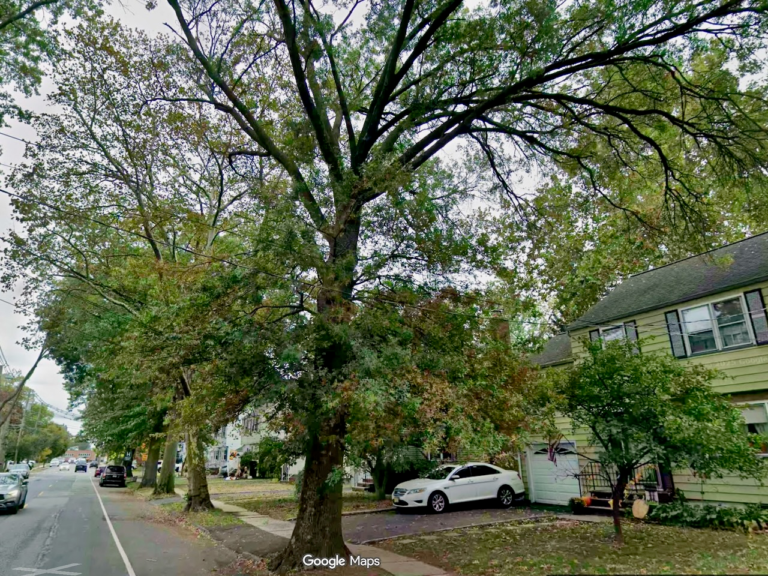
This tree, at 835 E. Milton Ave. in Rahway, is one of 16 trees slated for removal under a city contract. (via Google Maps)
Saturday, January 3, 2026
A contract approved by the Rahway City Council to remove more than a dozen large street trees has sparked debate over how the city balances safety, accessibility, and preservation, as well as how clearly those decisions are communicated to residents.
The council approved the tree removal contract during a brief holiday-season special meeting last week as part of a package of year-end financial resolutions. The resolution authorizes the removal of 16 city-owned trees identified through a review process that included evaluations by a certified arborist.
While the vote itself drew little discussion during the meeting, the decision has since prompted questions from a local advocacy group and from residents who say they feel left out of the process.
In an open email, Bob Markey of Save the Trees of Rahway said he did not attend the special meeting but learned afterward that the resolution approving the removals had passed.
Markey noted that the contract averages more than $4,100 per tree and said his initial site visits raised concerns about whether all of the trees slated for removal require it.
“I drove by each tree today and again have concerns that some on the list are only in need of maintenance and should not be removed,” Markey wrote.
Markey, a certified master gardener who also runs a gardening program for YMCA campers in Rahway, said the group has hired Steve Letkowski, owner of NJ Tree Doc and a licensed tree expert (LTE), to conduct an independent visual review of the trees.
According to Markey, the review will begin with a public meet-up at a local coffee shop, followed by a drive-by inspection of each listed tree. He said the effort is intended to provide an outside professional perspective and invite transparency.
Reaction to the removals has also surfaced from residents who say their own problem trees were not included in the city’s contract.
In comments responding to The Central Jerseyan’s initial report, several residents described long-running issues with trees in front of their homes, including uplifted sidewalks, interference with overhead wires, and repeated but unresolved requests for city intervention.
Some residents said they were previously told their trees would be evaluated or added to a removal list, only to find they were excluded from the current round of work. Others questioned why new trees were planted in locations where previous root damage had already caused safety or infrastructure problems.
Taken together, the responses suggest a broader frustration that extends beyond whether trees should be removed or preserved. Many residents appear to be seeking clearer criteria, better communication, and greater consistency in how the city evaluates and prioritizes street tree issues.
This tree, at 580 W. Lake Ave. in Rahway, is included in a city-approved tree removal contract. (via Google Maps)
City officials say decisions about tree removal involve more than arborist recommendations.
During last week’s council meeting, Mayor’s Chief of Staff Robert Landolfi, who also serves as executive director of the Rahway Redevelopment Agency, explained that arborist assessments are considered guidance, not mandates.
Landolfi said the city weighs a range of factors, including:
- Damage to sidewalks and curbs
- Impact on underground utilities and sewer lines
- Risk of falling limbs or structural failure
- Accessibility concerns for pedestrians, including residents using wheelchairs, strollers, or mobility aids
In some cases, Landolfi said, exposed roots and buckled sidewalks make areas effectively impassable, turning what might otherwise be a maintenance issue into a public safety concern.
“When an arborist says a tree needs to come down, that’s an easy decision,” Landolfi said during the meeting. “But even when removal isn’t explicitly recommended, we still have to look at the broader impact on safety and accessibility.”
The tree removal contract was approved as part of a consent agenda during a special meeting focused primarily on shifting year-end finances. No members of the public were present at the meeting, and all items passed unanimously.
For now, city officials maintain the removals are necessary to address long-standing safety and accessibility concerns, while advocates and residents alike are calling for clearer explanations of how those decisions are made.