
Edison Military Pay Ordinance Draws Concerns from Council Members
Residents warn proposed change could reduce compensation for service members called to active duty
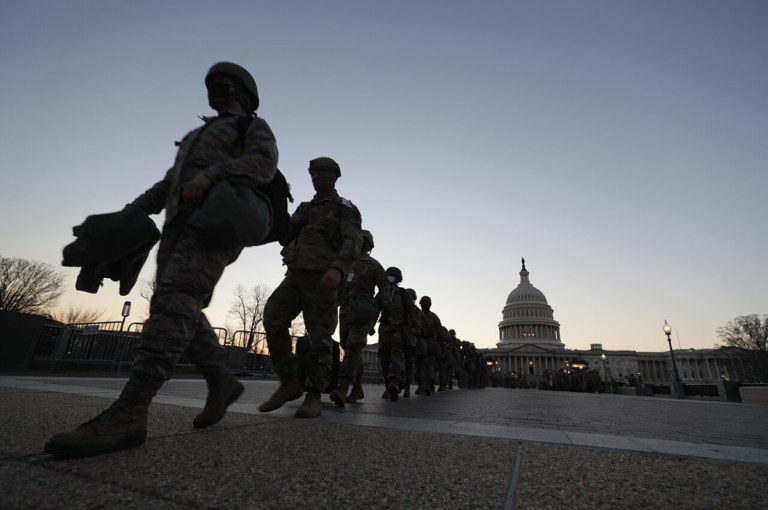
New Jersey National Guard Soldiers and Airmen from 1st Battalion, 114th Infantry Regiment, 508th Military Police Company, 108th Wing, and 177th Fighter Wing arrive near the Capitol to set up security positions in Washington, D.C. on Jan. 12, 2021, ahead of the Presidential Inauguration. (U.S. Air National Guard photo by Master Sgt. Matt Hecht)
Chris Howell | January 29, 2026
The Edison Township Council introduced a proposed ordinance Wednesday night that would change how the township pays employees who are called to military service, drawing emotional testimony from one veteran and debate from council members during a sparsely attended meeting held amid storm recovery across the region.
The combined council meeting came just days after a major winter storm and a water main break that shut down Route 1, possibly limiting public attendance. Still, several residents spoke out strongly against the military pay proposal, warning it could discourage service and place new financial burdens on township employees who serve in the armed forces.
Under current practice, township employees called to active duty or military training receive their full township salary in addition to their military pay.
The proposed ordinance would switch Edison to a differential pay model, meaning the township would only pay the difference between an employee’s regular salary and their military earnings. If the employee’s military pay is close to or higher than their township salary, the township would pay little or nothing.
Critics said that change could result in lower overall compensation for service members, particularly those assigned to active duty for extended periods.
The most forceful comments came from Anthony Sellers, a retired Marine Corps recruiter, who delivered an impassioned statement to the council.
DON’T LET AN ALGORITHM DECIDE YOUR NEWS
Independent hyperlocal news that’s fast, fair, and accurate.
“Recruiting is already hard enough. Trust me,” Sellers said. “Consistency, clarity and strong protection make it easier for people to raise their right hand and continue serving.”
Sellers questioned why the township would change a policy that already works.
“How many members of the township does this actually apply to?” he asked. “Is it a big number? Is it a small number? Why take away from us? We gave you guys everything.”
“Don’t take away from the veterans — not just the current ones but the future ones,” Sellers added.
His remarks appeared to resonate with several council members.
Councilman Richard Brescher asked whether Sellers could be included in reviewing the ordinance before it returns for a vote.
The township attorney responded that the ordinance was introduced to comply with state law, which encourages or requires municipalities to adopt differential pay models.
Brescher questioned whether the township should move forward regardless.
“If Governor Mikie Sherrill can defy federal law, then the township should be able to ignore state laws,” Brescher said, referencing recent state-run vaccine clinics.
He also made clear where he stands on the issue.
“I will never take a nickel from members of our military,” Brescher said. “I know things are getting crazy now with defunding everybody, but I’m an old-school Democrat. I don’t want to defund anybody — especially our military.”
Several residents echoed Sellers’ concerns, arguing that the ordinance could send the wrong message to township employees who balance civilian jobs with military service.
Speakers said the change could make it harder to recruit and retain employees who serve in the National Guard or Reserves, particularly at a time when military recruitment is already struggling nationwide.
In the end, the proposed ordinance advanced with Brescher as the lone no vote, but the discussion signaled that revisions or further review could be possible before final action.
The military pay ordinance was introduced Wednesday night and is expected to return for further discussion and a final vote on February 11.