
Edison Police Want a Military Anti-Mine Vehicle
The department says the armored truck would protect officers in active shooter and hostage situations. Critics of similar acquisitions nationwide have called them symbols of over-militarization. Edison residents will have a chance to weigh in before the vote.
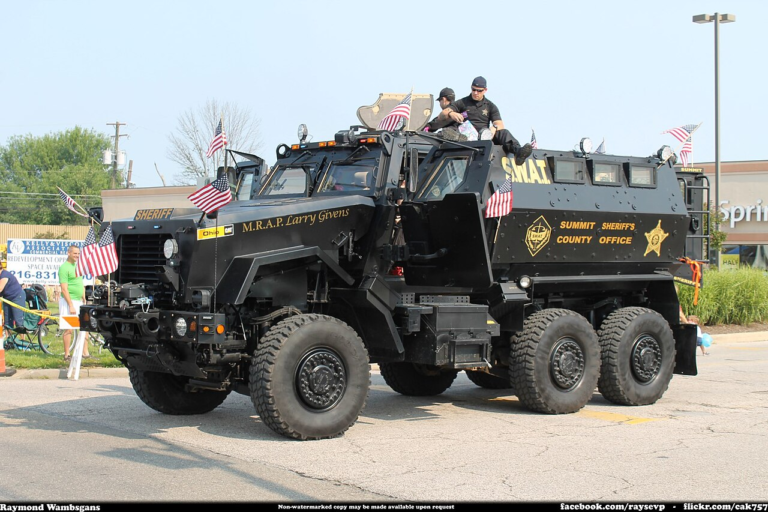
A 2015 photo of a Mine Resistant Ambush Protected Vehicle (MRAP) in Summit County, Ohio. Edison police are seeking authorization to acquire an MRAP through the federal 1033 Program. (Raymond Wambsgans)
Editor’s note: The Central Jerseyan is free to read and supported by advertising. If you value this kind of local reporting and want to help sustain it, you can become a citizen supporter on Patreon. Your contribution helps fund continued coverage of local government, schools, and community issues.
Chris Howell | June 8, 2026 ***Updated: 12:20 PM***
When Edison residents arrive at the Municipal Complex on Wednesday night, a vote on a military-grade armored vehicle will be on the agenda.
The Edison Police Department is seeking authorization to acquire a Mine Resistant Ambush Protected vehicle, known as an MRAP, through the federal government’s 1033 Program. The vehicle would come at no direct purchase cost to the township, though shipping and maintenance expenses would apply.
The request is brief and largely technical on its face. But it arrives in a national context that has made MRAP acquisitions by civilian police departments one of the more debated topics in American law enforcement over the past decade.
MRAPs were built for the Iraq War, designed to protect soldiers from roadside bombs. They are heavy vehicles that can weigh up to 40,000 pounds, carry up to a dozen people, and withstand blasts that would destroy a standard vehicle. When the military began retiring them after the Iraq and Afghanistan wars wound down, the federal government made them available to police departments.
DON’T LET AN ALGORITHM DECIDE YOUR NEWS
Sign up for The Central Jerseyan Newsletter for independent local news and events every weekend.
Edison’s resolution says the department wants to use the vehicle to respond to active shooter incidents, barricaded suspect situations, hostage incidents, and confined space emergencies. The SWAT team, which reports directly to the chief of police, would be the primary operator.
The vehicle would remain the property of the federal government and must be used solely for law enforcement purposes.
The 1033 Program reportedly has sent more than $7 billion worth of surplus military equipment to roughly 8,000 law enforcement agencies since it was established in 1997. It has also generated sustained controversy.
The debate intensified after Ferguson, Missouri, in 2014, when images of police in military gear confronting protesters drew widespread condemnation and prompted then-President Barack Obama to restrict the program temporarily in 2015. President Trump restored it in 2017.

A 2010 close-up photo of a Mine Resistant Ambush Protected Vehicle (MRAP) in Buffalo, New York. Edison police are seeking authorization to acquire an MRAP through the federal 1033 Program.
New Jersey has not been immune. State lawmakers pressed for oversight following Ferguson. Some nearby municipalities already have the armored military equipment. East Brunswick, a Middlesex County neighbor of Edison, obtained an MRAP in 2017. Kenilworth, in Union County, passed a nearly identical resolution to Edison’s just last year.
The ACLU has been among the program’s sharpest critics, arguing that military equipment in civilian hands creates a shift in how police approach their communities.
Supporters counter that the equipment is purely defensive and fills a genuine gap. Before programs like 1033, many departments relied on donated armored bank vehicles to protect officers. An MRAP, they argue, is a tool for keeping officers alive in the most dangerous situations, not a weapon.
While the vehicle itself costs nothing, the “free” characterization is not the complete picture. Shipping and maintenance for a comparable MRAP acquisition in New Jersey ran roughly $23,000. Edison’s resolution acknowledges the township will bear transportation and maintenance costs without specifying an amount.
There is also a lesser-known complication. Returning an MRAP once acquired can be difficult. Departments across the country have found that the Pentagon must approve any return, a process that can take months or years. The mayor of Davis, California, once called the program “low-cost storage for the federal government” after struggling to return one.
Edison’s police department currently has 199 sworn officers covering 32 square miles and more than 100,000 residents, its largest complement in nearly two decades.
The resolution is on the consent agenda, meaning it is grouped with dozens of routine approvals and is designed to pass without individual discussion unless a council member pulls it for separate debate. Residents who want the council to address it publicly can do so during the comment period before the consent agenda vote.
Key questions the council and administration have not yet answered on the record include the estimated transportation and maintenance costs, whether a specific vehicle has already been identified, and how it fits into the department’s broader resource planning.
Wednesday’s meeting begins at 6 p.m. at the Edison Municipal Complex, 100 Municipal Boulevard.
Editor’s note: The Central Jerseyan is free to read and supported by advertising. If you value this kind of local reporting and want to help sustain it, you can become a citizen supporter on Patreon. Your contribution helps fund continued coverage of local government, schools, and community issues.
***The images in this article have been updated to present more accurate depictions of MRAP vehicles used by police departments.***