
Edison's 2026 Budget Heads to a Final Vote
The council is expected to adopt an $181.8 million spending plan more than two months late. One unexplained line on Monday's agenda suggests the numbers could still change before the final vote.

One of several images celebrating the legacy of inventor Thomas Edison located outside the Edison Municipal Building. (The Central Jerseyan)
Editor’s note: The Central Jerseyan is free to read and supported by advertising. If you value this kind of local reporting and want to help sustain it, you can become a citizen supporter on Patreon. Your contribution helps fund continued coverage of local government, schools, and community issues.
Chris Howell | July 20, 2026
Edison’s long-delayed 2026 municipal budget is scheduled for final adoption Monday night, capping a process that began with a missed February deadline and included a council president publicly admitting he was holding up the introduction to seek cuts he never named.
The council will vote at Monday’s combined meeting on a budget totaling roughly $181.8 million, an increase of about 1.58 percent over last year. That is a modest increase in percentage terms, especially set against the monthslong fight that preceded it.
One line on the agenda, however, raises a question of its own. Just ahead of Monday’s public hearing, the agenda lists a resolution described only as “Resolution to Amend 2026 Budget.” No explanation, no dollar figures, and no indication of what is being changed appear anywhere in the posted agenda packet.
Budget amendments before final adoption are not unusual and can range from minor technical corrections to more substantive shifts in individual line items. But without any detail attached, residents heading into Monday’s public hearing will not know what, if anything, has changed since the budget was introduced in May.
DON’T LET AN ALGORITHM DECIDE YOUR NEWS
Sign up for The Central Jerseyan Newsletter for independent local news and events every weekend.
The Central Jerseyan has asked Council President Coyle, Council Vice President Kentos, and the Township Clerk’s office for clarity on the amendment.
The single biggest driver of this year’s budget growth is not fuel prices or storm overtime, the two costs Mayor Sam Joshi highlighted in a Facebook video back in April. It is health insurance.
The township’s health insurance costs rose from about $31 million to roughly $32.55 million, an increase of 5 percent that accounts for more than half of the entire budget’s growth. Edison is not alone in this. Health benefit costs tied to the state’s public employee insurance program have climbed sharply across New Jersey municipalities and school districts over the past two budget cycles.
Beyond insurance, the township added a new bond anticipation note that accounts for roughly $1.37 million of the increase in debt service costs. Pension and Social Security contributions rose about 5.2 percent, with the fund covering police and fire pensions specifically increasing by 6.85 percent.
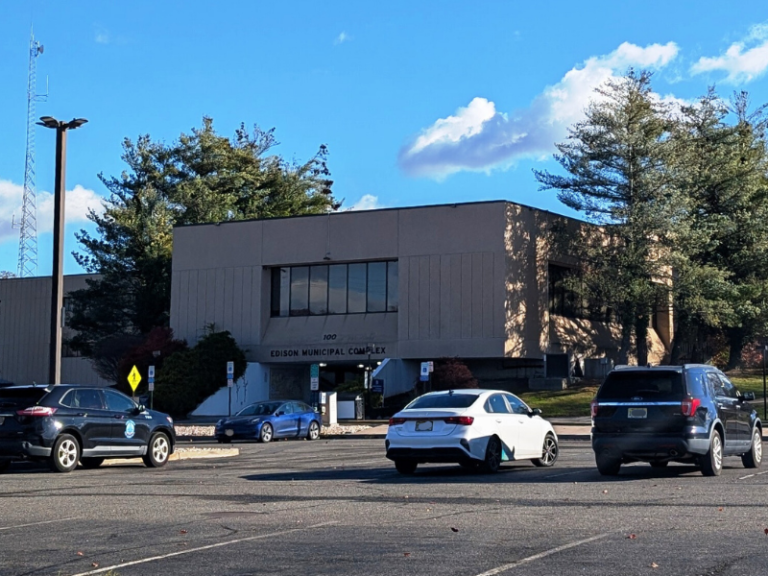
An undated image of the Edison Municipal Building.
Salaries and wages across the township grew modestly. Other operating expenses rose at a somewhat faster pace.
To help absorb these costs without a larger tax hike, the township is drawing down its surplus, its savings account, by 28 percent, from about $15.3 million to roughly $11 million.
Two different estimates of the tax impact have circulated this year, at two different points in the process.
In April, Mayor Joshi said in a video posted to Facebook that the monthly municipal tax increase would run about the cost of two gallons of gas. Based on New Jersey’s own tax assessment data at the time, that estimate worked out to roughly $10.18 a month.
At the June 24 council meeting, closer to the budget’s final form, Council President Joseph Coyle cited a more specific figure of about $11.25 a month.
Coyle also offered residents useful context on where that municipal increase fits relative to the rest of their tax bill. County taxes rose 12 percent this year. The open space tax rose 18 percent. School taxes rose 6 percent. The municipal portion, by comparison, is rising only about 5 percent, the smallest of the four major components of a typical Edison tax bill.
Because the budget was not adopted on time, the tax collector already mailed estimated third-quarter tax bills in June, built on a placeholder 5 percent increase, with actual bills to follow once Monday’s vote is final.
Public safety remains the township’s largest area of spending. Police salaries and wages alone total roughly $33.07 million in the 2026 budget, with fire department salaries and wages at approximately $24.3 million.
Utility budgets tell a mixed story. The water utility budget actually decreased this year, from about $17.37 million to roughly $16.35 million. The sewer utility budget rose from about $24.48 million to $26.22 million, an increase of $1.74 million, consistent with the township’s ongoing state-mandated sewer system repair program that The Central Jerseyan has covered extensively this year.
Solid waste collection, adopted as its own separate budget rather than folded into the general municipal fund, is also rising, from about $11.02 million to roughly $11.53 million. Salaries and other expenses within that budget both grew modestly, while the district is drawing on a larger surplus, $650,000 rather than $450,000 last year, to help offset the increase.
Total outstanding debt across the general fund, water utility, and sewer utility stands at approximately $163 million.
The budget’s path to Monday’s vote has been unusually public. Mayor Joshi was required by state law to submit a budget to the council by February 28. The council was then required to introduce it by early April. Neither deadline was met.
At the May 6 meeting, Coyle told a frustrated resident that he personally had been holding up the introduction because he wanted unspecified spending cuts included first. The budget was ultimately introduced on May 20, at a meeting that drew an unusually large crowd of firefighters, police union members, and youth sports families responding to rumors, which turned out to be false, that the budget would cut public safety staffing and recreation funding. Council President Coyle pledged that night that he did not believe any council member would vote to cut youth sports funding.
In the meantime, the township spent months operating under a series of temporary budget authorizations rather than an adopted spending plan. As of the most recent authorization, the township had spent 78.19 percent of last year’s entire current fund budget on temporary emergency appropriations while waiting for Monday’s vote, along with 68.76 percent of last year’s water budget and 73.19 percent of last year’s sewer budget.
Two Government Strategy Group contracts, worth a combined $229,200 for financial management and opioid settlement reporting services, were pulled from the agenda at the June 24 meeting specifically because the budget had not yet been adopted. Council Vice President Robert Kentos said at the time he did not want the township associated with the “stigma” of approving new spending contracts before the budget itself was final. Both contracts are back on Monday’s agenda.
The council will also finalize two large tax appeal settlements the same night, together worth close to $740,000 in refunds and credits to two commercial property owners. The larger of the two settlements resolves a series of appeals filed by 1013 Route One LLC, the Hartz Mountain-affiliated owner of the Top Golf property, covering tax years 2019 through 2026. The smaller settlement appeal was filed by Bradstone Rev NJ LLC, the owner of the Revlon property on Lincoln Highway, for tax years 2021 through 2025.
The council separately authorized itself, through a companion cap bank ordinance, to increase total spending by as much as 3.5 percent under the state’s appropriations cap law, more than the standard 2 percent limit. The adopted budget ultimately came in well under that ceiling, banking the difference for future years. This is a separate calculation from the tax levy itself, which is governed by its own 2 percent state cap, and from the 1.58 percent total budget growth described above.
Monday’s combined meeting begins at 6 p.m. at the Edison Municipal Complex, 100 Municipal Boulevard.
Editor’s note: The Central Jerseyan is free to read and supported by advertising. If you value this kind of local reporting and want to help sustain it, you can become a citizen supporter on Patreon. Your contribution helps fund continued coverage of local government, schools, and community issues.