
Edison Council Passes Emergency Funding, Ends Furloughs
The council unanimously passed emergency funding Thursday to reinstate furloughed employees. Councilman Richard Brescher also revealed, for the first time, that his walkout Monday was a deliberate strategy, not an accident.
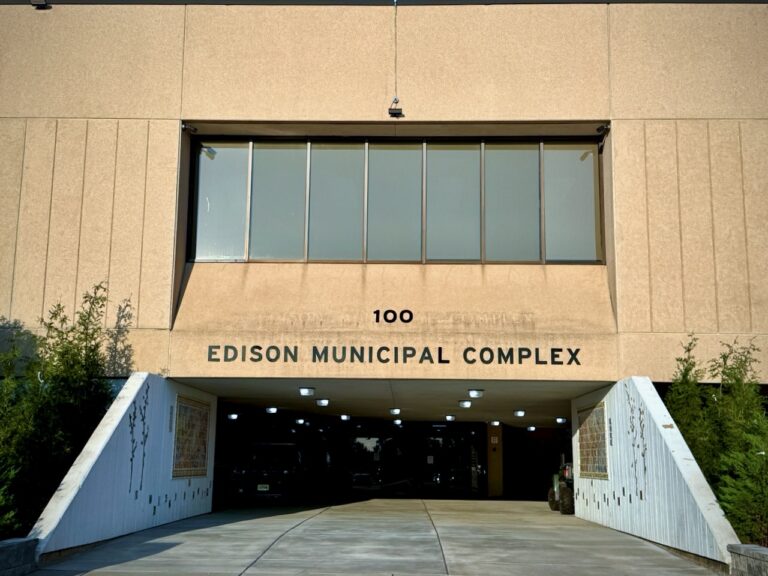
Edison Municipal Building (The Central Jerseyan)
Editor’s note: The Central Jerseyan is free to read and supported by advertising. If you value this kind of local reporting and want to help sustain it, you can become a citizen supporter on Patreon. Your contribution helps fund continued coverage of local government, schools, and community issues.
Chris Howell | July 24, 2026
Edison’s furloughed employees are back at work Friday with back pay, after the township council unanimously passed emergency spending Thursday night to keep the government funded through August.
Ten police officers had already been furloughed when the meeting started, New Jersey State PBA President Peter Andreave said. He warned the number “could grow substantially” without a vote that night. Edison PBA Local 75 President Michael Piperado said eight of those officers were seated beside him and warned 44 more were at risk.
Departments not tied to public safety were hit much harder by the partial shutdown. The president of AFSCME Local 3269, representing much of the township’s civilian workforce, put that union’s furlough rate at roughly 94 percent.
Business Administrator Sonia Alves-Viveiros confirmed after the vote that every position would be reinstated Friday, with back pay for the time missed.
DON’T LET AN ALGORITHM DECIDE YOUR NEWS
Sign up for The Central Jerseyan Newsletter for independent local news and events every weekend.
Mayor Sam Joshi signed an executive order Thursday formalizing that commitment. The order covers lost wages for employees furloughed July 22 and 23, along with leave accruals, pension service credit, seniority, and other benefits affected by the furlough.
“Glad to get Edison working again,” Joshi wrote on Facebook. “This executive order will restore the FULL back pay for all employees.”
Until Thursday, nobody seemed to know why Councilman Richard Brescher left Monday’s meeting during a recess, a departure that cost the council its quorum and blocked a budget vote that night. Brescher explained it himself, unprompted.
“If I did not walk out the other day and stop the quorum from voting, I would have voted no because I did not receive the documentation,” Brescher said. “If I voted no, you’d have to redo the document, the budget. You’d have to reintroduce it. The budget wouldn’t be approved for a month and a half.”
He called the move punting.

Edison Councilman Richard Brescher speaking during the July 23, 2026 special council meeting. (Edison Television via YouTube)
“So what I did was, it’s called punting it,” he said. “I punted it so that we can then get this information from the administration, which everybody thinks we should have anyway, and they have an additional two weeks to get it.”
Brescher said he deliberately broke the quorum rather than cast a vote that would have forced the township to reintroduce the budget. He said Council President Joseph Coyle had already acknowledged, at Monday’s meeting, that the administration owed him information he was still missing.
The council took two symbolic votes before approving the funding itself.
Councilman Ajay Patil moved to zero out the line item covering council members’ own salaries and wages for the emergency spending period. It passed 4-3, with Brescher, Council Vice President Robert Kentos, Councilman Biral Patel, and Patil voting yes, and Councilwoman Kelli Dima, Councilman Asaf Shmuel, and Coyle voting no.
Kentos then moved to zero out Mayor Sam Joshi’s salary for the same period.
“Let everyone feel the heat,” Kentos said.
That effort failed 3-4, with only Brescher, Kentos, and Patil voting yes.
The council will not be paid during this stretch of emergency funding. The mayor will.
Brescher also tried to withhold pay tied to Alves-Viveiros and the police chief, saying their offices were the source of documents he still hasn’t received. He backed off after the township attorney said the salary lines couldn’t be cleanly separated, and committed to meeting with the administration Friday to obtain vendor reports on EZPass tolls and vehicle fuel use, including a comparison against the prior administration.
Brescher’s financial claims grew more detailed Thursday, though some figures shifted from what he said Monday, and even within Thursday’s meeting.
He put the police department’s salary and wage budget at $33 million for the year, with $19 to $20 million already spent, roughly two-thirds of the year’s money at the year’s halfway point. He cited the EZPass figure he’s requesting as “over $100,000,” down from the “in excess of $300,000” he cited Monday. His take-home vehicle fuel estimate also varied within Thursday’s meeting, cited as $700,000 at one point and $800,000 later. Using the higher figure, he said combined savings of roughly $1 million could cut the proposed tax increase from 4.5 percent to about 3 percent. The administration has confirmed none of those figures.
Brescher also said the administration has been paying employees hired outside last year’s adopted budget since January without council authorization, which he said helps explain the shortfall. The administration has not addressed this claim on the record.
There was also confusion about when the town actually ran out of funds. Alves-Viveiros said the last emergency spending measure the council passed kept paychecks flowing through the pay period ending July 22, narrower than the “end of the month” framing used earlier in the week.
Monday’s council meeting had originally been scheduled for Wednesday, July 22, and was moved up over a council member’s scheduling conflict. Kentos asked whether anyone had recognized that moving the meeting earlier could expose the township to the cutoff sooner than planned. Alves-Viveiros said the council has historically waited until the last possible moment to approve emergency spending, a practice she said was the council’s to change, not hers. Kentos did not get a more specific answer.
The full 2026 budget remains scheduled for a public hearing and vote August 3. Whether Brescher will have the documentation he says he needs by then remains an open question.
Editor’s note: The Central Jerseyan is free to read and supported by advertising. If you value this kind of local reporting and want to help sustain it, you can become a citizen supporter on Patreon. Your contribution helps fund continued coverage of local government, schools, and community issues.