
Rahway Tables Budget Vote Pending State Financing Review
A pending state review of an employee payout financing plan pushes the city's $79.6 million budget past another deadline, as residents renew concerns about transparency.
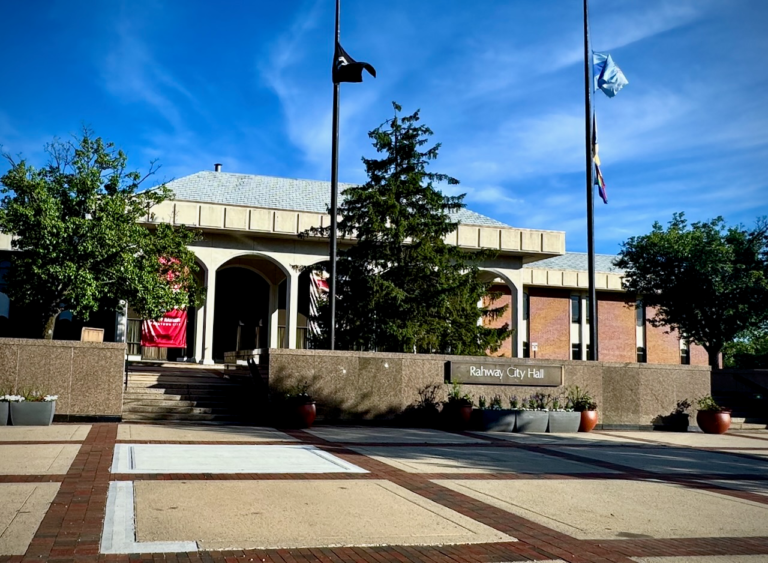
Rahway City Hall, June 2026. (The Central Jerseyan)
Editor’s note: The Central Jerseyan is free to read and supported by advertising. If you value this kind of local reporting and want to help sustain it, you can become a citizen supporter on Patreon. Your contribution helps fund continued coverage of local government, schools, and community issues.
Chris Howell | August 5, 2026
Rahway City Council held its public hearing on the 2026 municipal budget Monday night, but did not vote on it. The vote is on hold while the city waits for state approval of a separate financing plan tied to employee retirement payouts.
City auditor Dieter Lerch, managing partner of Lerch, Vinci & Bliss, walked the council through the budget’s structure. The city’s total spending plan, covering the municipal budget along with the water, sewer, and parking utilities, tops $100 million. The municipal budget itself is $79,643,000. The largest shares go toward salaries and wages, 37 percent, and employee insurance, 20 percent, with the remainder split between department expenses, pension costs, debt service, and other obligations.
Business Administrator Matthew Pukavich said the amount to be raised through property taxes is $46,502,000, an increase of $1,045,000 over 2025. He attributed much of the year’s cost pressure to a $3 million rise in health benefit costs. The city used a $2.1 million state legislative grant, along with surplus funds and PILOT revenue, to offset $5.5 million of that increase, holding the net tax impact to roughly $1 million.
Lerch put that in perspective for residents directly. “This increase in this budget is approximately 2 percent, $84,” he said. “Obviously we all want a zero increase, but unfortunately you were faced with a $3 million increase in health insurance alone… The increase could have been hundreds of dollars. Instead, you pursued every avenue available to you.”
DON’T LET AN ALGORITHM DECIDE YOUR NEWS
Sign up for The Central Jerseyan Newsletter for independent local news and events every weekend.
The budget’s introduction process drew renewed criticism from residents who have raised the issue before.
Andrew Garcia Phillips, who ran unsuccessfully for one of the council’s at-large seats in this year’s Democratic primary, asked the council directly why it introduced the budget in July without releasing the document itself beforehand. “Can you explain why it is that you decided to not disclose the budget until after you introduced it last month?” he asked. “You’ve never done that before.”
Alan Levy, a Republican council candidate this November, made a more detailed procedural argument. He said the agenda packet for the July 6 meeting did not include the actual budget document. He cited state law requiring a budget to be introduced in writing before a first reading, which he said can be done “by title” only if the full document was already introduced in writing beforehand. “There’s different versions of the budget,” Levy said, pointing to what he described as an earlier draft still posted on the city’s website that differs from the version he said was ultimately filed with the state. “So which one did you vote for on July 6? Do you even know which one you voted for?”
Lisa Vandever, who is married to Levy, raised a different, related concern about the council’s own deliberations. She noted she’d flagged the budget’s late introduction back in June, when neighboring towns had already completed their budget processes, and said residents still had to track down the document themselves after it was introduced. “This is the most important vote you will cast all year,” Vandever told the council. “It determines how tens of millions of taxpayer dollars, nearly 80 million dollars, will be spent.” She asked each council member to be prepared to explain, before the eventual vote, what questions they’d asked about the budget and what, if anything, they’d sought to change.
Lerch pushed back directly on the process concerns. “The process that the City of Rahway conducted with respect to this budget complies 100 percent with state statute,” he said. He said the July 6 introduction started a required 28-day clock ahead of the public hearing. He added that the budget was filed with the state’s Division of Local Government Services within three days of introduction, as required, and was publicly advertised at least 10 days before Monday’s hearing. Lerch did not directly address Levy’s claim that multiple, differing versions of the budget document have appeared on the city’s website.
The delay itself is tied to a separate financing matter. The city has an application pending before the state Local Finance Board to approve repaying a terminal pay obligation, the accumulated sick and vacation payouts owed to retired employees, over five years rather than all at once. “The application before the board is for approval to repay its terminal payout… over five years,” Lerch said. “That hearing is scheduled before the Local Finance Board, August 12th… after which time that action can be taken on this budget.”
Editor’s note: The Central Jerseyan is free to read and supported by advertising. If you value this kind of local reporting and want to help sustain it, you can become a citizen supporter on Patreon. Your contribution helps fund continued coverage of local government, schools, and community issues.