
Rahway Schools See Increase in Recorded Violent Incidents, Officials Say Context Matters
District leaders say some incidents occurred off school grounds and stress that state reporting rules capture a wide range of behaviors.
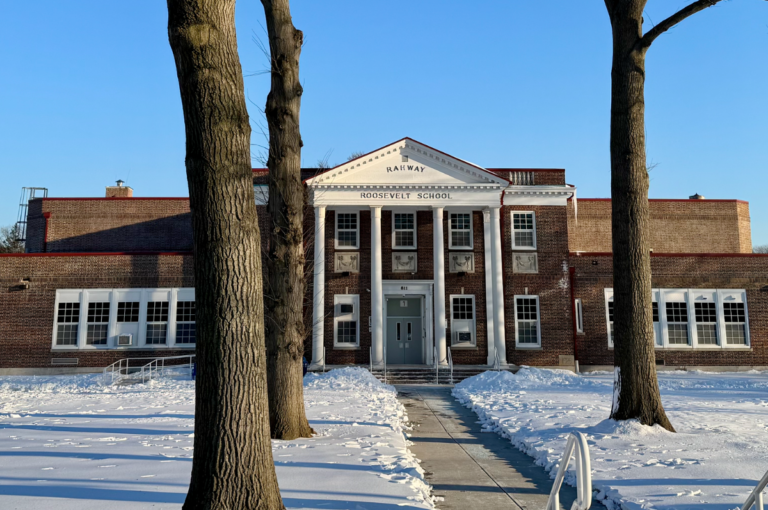
Roosevelent Elementary School in Rahway had 7 safety incidents during the first half of the 2025-2026 school year, according to Superintendent Aleya Shoieb during Tuesday’s school board meeting. (The Central Jerseyan)
Chris Howell | January 29, 2026 (Updated: January 30)
As concerns about school safety remain top of mind for parents, Rahway school officials used Tuesday night’s Board of Education meeting to put new student safety data into context. Superintendent Dr. Aleya Shoieb presented the district’s Student Safety Data System (SSDS) report for the first half of the school year. The document is a state-mandated review that tracks a wide range of student-related incidents occurring both on and off school grounds.
According to the report, Rahway schools recorded 45 total incidents during the first half of the school year, including 15 at Rahway High School and seven at Roosevelt Elementary School.
Shoieb explained that the SSDS data captures several broad categories, including violence, vandalism, substance-related incidents, weapons, and HIB (Harassment, Intimidation, and Bullying) cases, as well as an “other” category that can encompass procedural violations. Within those categories are dozens of specific incident types, ranging from fights and assaults to vandalism, theft, and missed disciplinary obligations.
“What the data shows was that there was a decrease in incidences related to weapons and HIB confirmed,” Shoieb said. “And the data shows that there is an increase in incidences of violence, vandalism, substances, HIB alleged, and other incidents.”
DON’T LET AN ALGORITHM DECIDE YOUR NEWS
Independent hyperlocal news that’s fast, fair, and accurate.
The district reported four confirmed HIB cases during the first half of the school year, a decrease from the same period last year. Overall, however, Shoieb said the data showed a 10 percent increase in incidents classified as violence.
She cautioned that the violence category includes incidents that did not necessarily take place inside school buildings.
“Some of the fighting that happened was at the very beginning of the school year,” Shoieb said, noting that several incidents occurred off school grounds. Because the district remains responsible for students in those situations, the incidents must still be included in the report.
The superintendent said her administration would continue HIB training for staff, students, and families, continue training on restorative practices for all staff, and continue to monitor and address chronic absenteeism and lateness. The district is also planning a Parent Academy on HIB in the next few months, and an increase in small-group interventions and assemblies for students.
Board members asked for clarification about how incidents are categorized, particularly the broad “other” category, which can be alarming without explanation.
Board Vice President Shanna Raysick said understanding those distinctions matters for parents reading the report.
“I just think it’s good to clarify just a little bit so the rest of us are at ease,” Raysick said. “Because tell me it’s just a detention that someone didn’t show up to—I’m like, okay, as a parent—versus something that could be a little bit… my mind can go anywhere.”
Board President Joseph Toma expressed hope that the district’s parent academies and outreach efforts could help address issues such as fighting that occurs off school grounds.
“We’re a community,” Toma said. “The more we work together, the better we can be for all of us.”
Board member Jennifer Moteiro asked how Rahway’s numbers compare with other districts. Shoieb said she had not yet reviewed comparative data. Districts are not required to submit reports to the state until the end of the month. She said she plans to raise the question at an upcoming superintendent roundtable.
District officials stressed that the SSDS report is a compliance and monitoring tool, not a standalone measure of school climate, and that administrators continue to review the data to identify trends and areas for intervention.
Editor’s note: The Central Jerseyan is free to read and supported by advertising. If you value this kind of local reporting and want to help sustain it, you can become a citizen supporter on Patreon. Your contribution helps fund continued coverage of local government, schools, and community issues.
***Correction: A previous version of this article quoted Superintendent Aleya Shoieb as citing HIV-related cases as a statistic in the SSDS report. The statistic is in fact HIB (Harassment, Intimidation, and Bullying).***
***Correction: A previous version of this article misidentified Board Member Shanna Raysick.***