
How Rahway Quietly Spent $200K on A Water Utility Sale Study
Financial records show the city spent at least $200,000 exploring a sale of its public water utility, paid mostly through the utility's own ratepayer accounts and described in language that gave residents little indication of what was actually being studied.
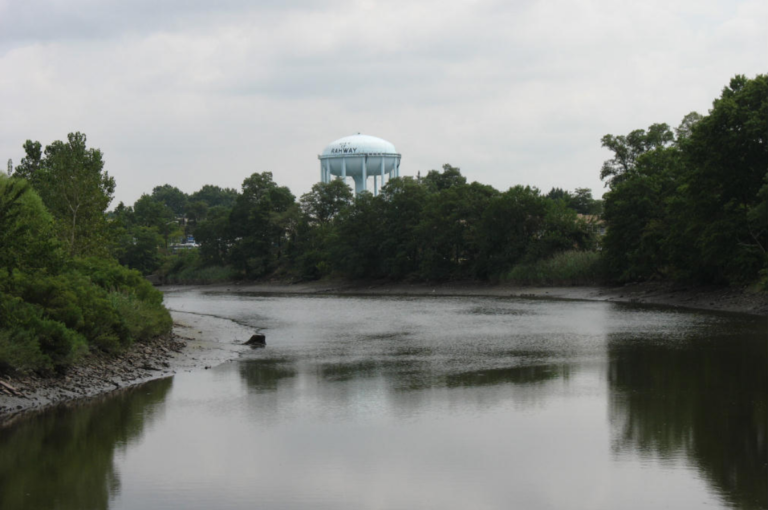
A view from the Lawrence St. Bridge of the Rahway River with the city water tower rising above the tree line in August 2006. The image illustrates reporting on the Rahway City Council’s consideration of a bid process that could have led to the sale of the public water utility.
Editor’s note: The Central Jerseyan is free to read and supported by advertising. If you value this kind of local reporting and want to help sustain it, you can become a citizen supporter on Patreon or make a one-time donation on Givebutter. Your contribution helps fund continued coverage of local government, schools, and community issues.
Chris Howell | May 14, 2026
One resolution listed $50,000 for “Professional Engineering Services — Water Treatment Plant Evaluation / Capital Improvement Planning.” Another provided $30,000 for what it called “Professional Lead Services Associated with the Water Utility,” a likely typo for “Legal Services,” which was passed without discussion and never corrected. A third measure authorized an additional $60,000 to the same law firm using similar language.
While all three may sound routine, they represent just a portion of what the City of Rahway paid for a study exploring the sale of its public water utility.
Financial records obtained by The Central Jerseyan through an open public records request show the city spent at least $200,000 to study the sale, which collapsed one month after city leaders unveiled and approved it. The study, which Mayor Raymond Giacobbe said lasted nearly a year, was mostly funded through the water utility and is still being paid for.
The firms that received the funding include T&M Associates, an engineering firm with offices in 39 states and Puerto Rico, and Waters, McPherson, McNeill, P.C., a law firm based in Secaucus. Invoices show both contracts appear to have exceeded the city’s authorized spending caps by a combined total of more than $60,000. It is not clear why. A public records search turned up no evidence that the council authorized additional spending.
DON’T LET AN ALGORITHM DECIDE YOUR NEWS
Sign up for The Central Jerseyan Newsletter for independent hyperlocal news and events every Sunday.
The records also identify a third firm, MAD Global Strategy, LLC, a public relations and strategy consultant. The company’s name never appears on city resolutions or public documents because payments first went to Waters, McPherson, McNeill, which then paid MAD Global out of its own invoices, an arrangement commonly known as a passthrough payment. At least $28,750 in MAD Global fees appear in the financial records obtained by The Central Jerseyan. It is not clear why the firm did not hold a direct contract with the city, or precisely what work it performed in connection with the study.
None of the officials or firms contacted responded to requests for comment by deadline.
City officials have stressed that any sale of the municipal water utility would require voter approval by referendum.
What also makes the spending notable is where the money came from. The resolutions authorizing the engineering and legal work directed payments from the city’s water utility operating accounts, funds collected from Rahway residents through their monthly water bills. Residents whose bills helped fund the study had no way of knowing it from publicly available documents. The resolutions describing the work made no mention of a potential sale, a bid process, or privatization.
The contrast with other spending is pointed. A recent resolution authorizing a $300,000 contract for arts programming at the Union County Performing Arts Center included five detailed clauses explaining exactly what the city was purchasing and why. The water utility study received no such explanation, even though it cost more and carried far greater public policy implications.
The process to sell the water utility was canceled in March 2026 following swift and overwhelming public opposition. Residents packed the council chambers as the administration unveiled the proposal in February, and the council voted to cancel the bidding process within weeks. But even as the council voted to cancel the bidding process, Mayor Giacobbe said in clear terms that the door remains open.
“Canceling the receipt of bids does not end the conversation,” Giacobbe said. “It creates the space that we need to continue the conversation to fully understand the financial, operational, and long-term impacts.”
What is clear is that the city is still paying for the study and will be for some time. Waters, McPherson, McNeill billed the city $25,984 in February 2026 and another $10,407 in March, after the council formally voted to cancel. Three invoices totaling $64,905 remain unpaid as of April 2026.
The revelations about the cost of the water utility study and how it was paid for arise as the city faces separate unanswered questions. It’s still unclear how officials plan to finance more than $7 million in downtown property acquisitions bonded over the past several years. As The Central Jerseyan previously reported, construction budgets have not been disclosed for any of the acquired properties. The mayor’s office also faces growing pressure to settle a contract dispute with DPW workers that has dragged on for more than a year.
Editor’s note: The Central Jerseyan is free to read and supported by advertising. If you value this kind of local reporting and want to help sustain it, you can become a citizen supporter on Patreon. Your contribution helps fund continued coverage of local government, schools, and community issues.