
Rahway Superintendent on Facilities, Literacy, and Student Success
In the second half of an in-depth interview, Dr. Aleya Shoieb and Principal Patricia Volino-Reinoso discuss facility needs, literacy programs, staffing, and warn parents about chronic absenteeism.
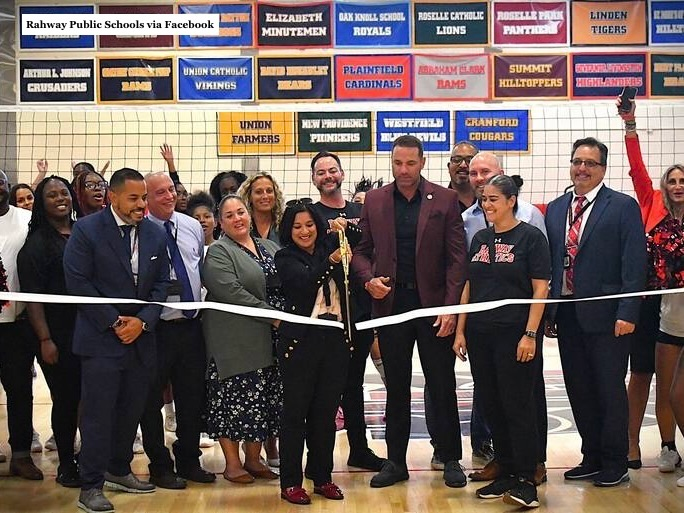
Rahway Superintendent Aleya Shoieb cuts the ribbon at a school event alongside staff, students, and community leaders. (Rahway Public Schools via Facebook)
Part One of the Interview:
AI Superintendent On AI, Cell Phones, and Safety
Thursday, September 11, 2025
What are some recent facility upgrades you’re most proud of?
Dr. Shoieb: Our strategic plan outlines expansions, community involvement, and facility improvements. We will likely pursue a referendum, which I’ve mentioned at school board meetings, because we still face $160 million worth of work in the district.
We want to expand programs and reduce the need to bus students out of the district. But we’re running out of space in some of our buildings, and we’re looking at how we can expand.
Let’s talk about you and your background. You started in Rahway as Franklin Elementary’s principal, then became assistant superintendent, and now superintendent. Where did your career begin?
Dr. Shoieb: I was born in Ottawa, Canada. My parents were born in Guyana. My husband and I celebrated our 27th wedding anniversary this summer. We have two children. Our daughter is 19 and attends Montclair University. Our 15-year-old son attends public school in Jersey City, where we live.
And I began teaching in Jersey City. For more than 15 years, I worked as a social studies teacher. Then I got my master’s in literacy education and became a reading specialist for elementary schoolers. Then I became an assistant principal and principal. I’ve been in education for 23 years now, and I love it all.
What do you like to do outside of work?
Dr. Shoieb: I love dance. It was a huge part of my life growing up — hip hop and breaking. My brother even founded Ottawa’s first urban dance school. He was on So You Think You Can Dance Canada. I also enjoy traveling with my family. This summer we went to Spain and Morocco.
What’s the purpose of public education to you?
Dr. Shoieb: Oh gosh! I could go on and on about this… To provide every child with the best education possible, and to really individualize to meet their needs. In public education, our staff is so passionate and dedicated. I can see it in just the way they interact with students. And I want them to be happy when they come to school every day, and have a voice, and have choices. We want the best for our children.
Let’s wrap up with some more questions from parents. What discussions have there been about expanding the use of the AI security scanners?
Dr. Shoieb: They’re currently at the high school and are being discussed for the middle school. But nothing has been decided.
What efforts are officials taking to cut down on school fights?
Dr. Shoieb: There’s a cultural piece there where we have to continue to educate and really spend time with our children to help them understand that fighting isn’t the first and foremost option. What we’re finding is that they often occur off school grounds, but we are still responsible for them. So students are disciplined regardless. We’re also telling students that even if they fight off campus after school, they’re still going to be suspended.
Have there been any discussions about expanding uniforms beyond the middle school academy?
Dr. Shoieb: Middle school has them, high school doesn’t. Past surveys found the community didn’t want them at that level. The issue may be revisited.
Edel Quinn asked, “Why are so many students failing, and how can we teach Rahway students to be better readers?”
Dr. Shoieb: We’ve revamped curriculum and programming. We’ve implemented Fundations at the elementary level. We have instructional coaches who work with teachers to implement best practices, and we’ve also implemented Heggerty Phonemic Awareness.
Teachers also engage with students in guided reading, and work with them on developing their literacy skills in a way that focuses on what skills each student needs help in. What we have noted, though, in our test scores is that overall students really struggle with reading informational texts. And so that is a focus for us.
Caity Cordova wants to know if you “meet with superintendents and [boards of education] from neighboring districts that are succeeding and learn from them?”
Dr. Shoieb: Yes, I am part of a county superintendent round table. There are over 20 superintendents, and we come together with a county superintendent. We exchange ideas, and we talk about things that are working well in our districts. So I can reach out to my colleagues and say, “Hey, I was thinking about this. I noticed that you implemented it. How is it working?”
For example, I know Linden is implementing uniforms at a high school level, and I will chat with [Linden Superintendent Atiya Y. Perkins] about how that is going. So yes, we collaborate.
Several parents raised questions about special education programs and whether the district has enough teachers. Is the district facing a staffing shortage?
Dr. Shoieb: We worked around the clock to fill every vacancy that we could, and we have maybe five to seven vacancies right now. At the next board meeting, I’m sure it’s going to be less than that.
Right now, what we struggle with is finding special education teachers. But we have special ed teachers who can teach a sixth period so that students aren’t missing out, and a substitute isn’t leading the class. We might have to bring in a substitute for things like maternity leave, but this year specifically, we were really lucky. We’re also in good shape with bilingual ESL teachers.
This is an age-old question for public schools. Some residents do not have students in the system and want to know why they are still required to pay taxes. What’s your response to those residents?
Dr. Shoieb: If we’re a community, and we’re contributing to the wellness of the community, then our taxes are going to develop our pride and joy — all of our children. They’re a part of the community, and they are going to contribute to the well-being of the community.
I want to say that we’re pretty fiscally responsible with the taxes that are coming our way. We’re looking at every penny, every program, and how to develop our children. We do appreciate the tax dollars that are given to the district so we can work to develop our community members, so we can be a good community.
Principal Volino-Reinoso: Something I think that is unique about Rahway is our relationship with city officials. Dr. Shoieb and Mayor Giacobbe really work hard to keep things as cost-effective as possible. It’s that relationship that keeps things from skyrocketing even more, while still getting the services that we enjoy.
Dr. Shoieb: I did want to add one more thing, if you don’t mind.
Of course!
Dr. Shoieb: It’s about chronic absenteeism. This is really important. This is state-mandated: If you have 18 absences or more, you’re considered chronically absent and could fail a course. This affects the district as a whole because if you’re chronically absent, you’re not getting the skills needed to move up to the next grade level, and that impacts everything. It impacts you being at school and forming those relationships with your fellow students, not getting the skills needed, and it can also affect test scores.
As a parent with children in the district, I know that you need a doctor’s note for an excused absence. The district also wants students to stay home when they have a fever or flu-like symptoms, which doesn’t always necessitate a doctor’s visit. How would you like to see parents strike that balance so that they don’t have to constantly take their kids to the doctor?
Dr. Shoieb: If it’s a one-off, then at least call the main office and let them know. But just so you know, even with doctor’s notes, if a student has 18 absences or more, they’re still considered chronically absent.
Dr. Shoieb, thank you for your time.
Dr. Shoieb: Thank you — I’m excited about building a strong partnership.