
Rahway Superintendent Aleya Shoieb Talks AI, Phones, and Safety
In a wide-ranging interview, Dr. Aleya Shoieb and Principal Patricia Volino-Reinoso explain how the district is rolling out AI in classrooms, enforcing a stricter cell phone policy, and addressing parent concerns about emergencies.
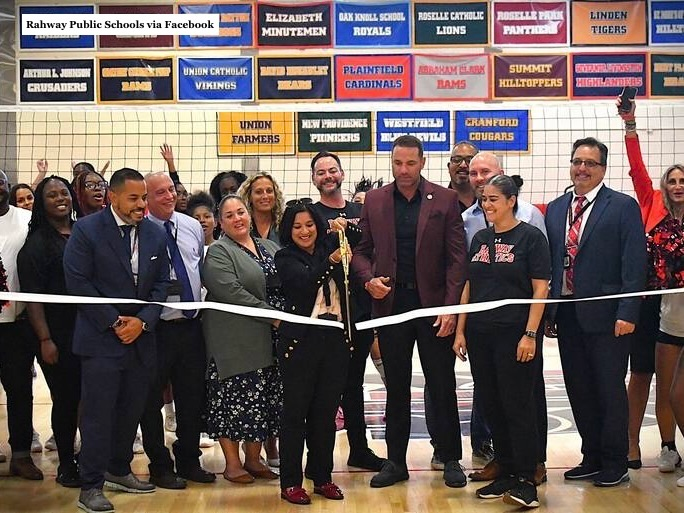
Rahway Superintendent Aleya Shoieb cuts the ribbon at a school event alongside staff, students, and community leaders. (Rahway Public Schools via Facebook)
Tuesday, September 9, 2025
Rahway Superintendent Aleya Shoieb sat down with The Central Jerseyan for an incredibly open and candid interview. The full interview is so in-depth that it’s been broken up into two parts to make it easier for readers to fully digest.
This first half focuses on technology and safety. In it, Dr. Shoieb and Principal of Special Projects Patricia Volino-Reinoso answer questions about artificial intelligence in the classroom, the district’s strict new cell phone policy, and student safety.
This transcript has been edited for clarity.
Dr. Shoieb and Principal Volino-Reinoso, thank you for your time. With the new school year underway, I want to start with the district’s AI and cell phone policies. I know many districts use the state-recommended template, but Rahway didn’t fill out every section. Why stop where you did?
Dr. Shoieb: I’m glad that you asked that question. When we go to implement a policy, we want to move carefully. If we aren’t fully confident in our research, staff training, or community feedback, it’s better to roll out in phases. We have a technology committee and a policy committee that we’re working with. So, this policy will be revisited. We’re also working on a handbook for staff. We’re in the early stages.
The policy says the superintendent and an AI coordinator will develop the district’s AI plan. Do you have an AI coordinator?
Dr. Shoieb: Yes, Dr. Linda Lampert is our AI coordinator. She also manages district assessment, communications, and technology. We’ll be working closely together to speak with many different stakeholders this year to create a handbook.
We were also awarded a $1 million grant through the Verizon Innovative Learning Schools (VILS) program. For our first admin retreat, Verizon sent a coach to speak with us about digital literacy. We also discussed how to use AI effectively in the classroom. Through the initiative, Verizon will also provide support on how to utilize AI moving forward. Meanwhile, Dr. Lampert will continue to do research with our teams.
Is that Verizon initiative something that’s already underway?
Dr. Shoieb: Yes, we were awarded it last year. It’s with the high school and the middle school. And it’s something that I really wanted to see happen for the district because Verizon provides touchscreen devices for all students. It’s all paid for by the VILS grant. The program also provides two technology coaches who go into classrooms and work with teachers on digital literacy and professional development.
This was a big part of implementing the new curriculum we rolled out last year for grades K–8. We also have educational technology specialists at the elementary level who go into classrooms and work with teachers because not everybody is comfortable with technology. We want to maximize every tool that we have.
Through VILS, we can apply for a Verizon Learning Lab. Once we complete the application process, Verizon will build the lab for us, and then we can schedule elective periods for the high school and middle school students.
How do you determine which AI tools are approved?
Dr. Shoieb: Right now, we are a Google district and only using Google’s built-in AI tools. New tools will be reviewed by the technology committee and the AI coordinator.
Principal Volino-Reinoso: This first phase is about research and instruction, both on the teacher side and on the student side. We realize that we are preparing our children for the future. AI is going to be a part of their lives, and we are the stepping stones for how to use it appropriately. But we’re also all learning together, and the Verizon program is a great asset for us to be on that level of digital literacy.
So it sounds like in this early phase, teachers are a big part of AI education and best practices.
Dr. Shoieb: Absolutely. As part of the Verizon initiative, teachers have to go to a number of workshops and video trainings. If they need more support, the Verizon coaches go into the classrooms to help them in those areas. They’re also running coaching cycles with the teachers to make sure the staff is aligned with the curriculum and properly instructing students in digital literacy.
Based on the AI policy, it looks like you’re still working on clear disciplinary standards since you’re still in the research phase.
Dr. Shoieb: Correct. This is the year to create standards and structure for students.
Principal Volino-Reinoso: We’re approaching AI the same way we did when we started using Google Classroom. At that time, once students were able to work on a project at the same time online, we had to reexamine what academic integrity and academic dishonesty really meant. So a child or family may not see the use of AI as plagiarism or academic dishonesty, and we cannot spring that on the children. We have to work with them to make them understand how to use it responsibly while still bettering their own education. But that will take time.
I would also like to talk about the school district’s new and stricter cell phone policy. What steps went into creating this new policy?
Dr. Shoieb: We surveyed the staff, we surveyed the students, and we met with the policy committee. The whole administrative team came together, and we discussed pros and cons before the policy was even developed.
Principal Volino-Reinoso: We established a committee specifically on cell phone usage. A lot of research and surveys went out before determining which direction to go. People in our community picked what works for us.
Unfortunately, I was a teacher here in 2001, and that changed our community because parents really wanted to be able to get in touch with their children at a moment’s notice. They didn’t like the idea of calling the office anymore. Parents being able to reach their children in an emergency was a big factor for us.
The policy bans the use of nearly all personal electronic devices during class, except possibly at lunch, depending on the school.
Principal Volino-Reinoso: That was a big debate. We settled on having accessibility while being responsible. When teachers were just starting to use technology, we didn’t have a district device for every student, so teachers allowed students to look things up on their cell phones. That’s no longer the case.
Also, the professional committee I worked with on this issue debated how cell phones affect students’ personal lives. In the hallway between classes, we want them walking to class, talking to friends, and getting to the next place quickly. We don’t want them staring at their phones.
Additionally, for autonomy, we don’t want them calling parents between classes for no reason. They need to be able to follow their schedule.
Dr. Shoieb: Correct. At the same time, during lunch, it’s at the discretion of the building administrators and the teachers.
But I want to say this as well: It’s important for parents to understand that if there is a situation at a school, we need to know what it is before a parent is called. For example, if a student needs a bandage, some might pick up their phone to call Mom and Dad. Then Mom and Dad are coming to school, saying they got a call, and we, the administrators, don’t know what’s happening.
We have clear systems in place so that students know we’re looking out for them. We can call Mom and Dad, no problem, but use the office phone.
What are some of the systems and technologies that the district uses to keep parents notified, especially in the event of an emergency?
Dr. Shoieb: We use text messages and email alerts, robocalls, and our website. The text alerts and emails let us get messages to parents very quickly. We also have direct contact with Rahway police for emergencies. We have a security manager on campus. We upgraded our camera systems this year. At the high school, we implemented an AI detection system for safety and security. I would prefer to be proactive and fix things before they happen, but when we have to respond, we do it quickly to ensure safety and security.
What happens when a phone is confiscated?
Dr. Shoieb: The vice principal assigned to that grade level contacts parents, and they pick it up from that office.
What I’m hoping we see is more students interacting with each other, building friendships, and staying off their devices so they can have more face-to-face interaction and just enjoy each other’s company. In the past, we’ve seen students sitting right next to each other and texting instead of talking.
Principal Volino-Reinoso: There’s a lot of research that shows students are not socializing as much as they should be when they’re on their cell phones.
Dr. Shoieb: Can you tell us what the biggest concerns are that you’re hearing from parents (about the new cell phone policy)?
I asked parents to weigh in on Facebook ahead of this conversation, and the biggest concern seemed to be about communication during an emergency.
Dr. Shoieb: Safety is our priority. I get it — I’m a parent. There was a situation two school years ago where there was an evacuation, students called their parents, and parents started to show up at the evacuation site. It caused chaos.
Principal Volino-Reinoso: Having parents rush to the school can also block the route of emergency vehicles. And when parents show up at an evacuation site, it alerts everyone that hundreds of children are standing in one spot. We can’t have that.
One last question about the cell phone policy. It states that a third offense can result in an ISR. Is that in-school suspension?
Dr. Shoieb: It stands for In-School Reflection. It’s less about punishment and more about thinking through mistakes. The focus is on personal responsibility. We’re not asking students to lock their phones in a pouch. They can keep them in their lockers if they’d like. We just want students to follow the rules.
Principal Volino-Reinoso: And overall, mistakes are different from intentional actions. A phone accidentally buzzing in a student’s pocket is different from deliberately avoiding learning by texting in class. We’re teaching students how to become young adults. Nobody is going to force them to put their phone in a pouch when they’re at work or in a meeting. They have to learn to be responsible, and this is the age at which we can teach them.
Some parents expressed concern in our public Facebook chat about too much screen time on devices during class, especially for younger students. How do you balance that?
Dr. Shoieb: We want to make sure students aren’t spending all day sitting in front of computers. That’s where our professional development training comes in for teachers, to make sure students also take part in reading, discussion, and note-taking. After COVID, we’re intentional about restoring that balance.
Part Two of the Interview:
Rahway Superintendent on AI, Cell Phones, and Safety