Rahway Halts Water Utility Bid Process One Month After Unanimous Vote to Seek Buyers
City leaders pause potential water privatization after public backlash, but offer no clear plan for what comes next.
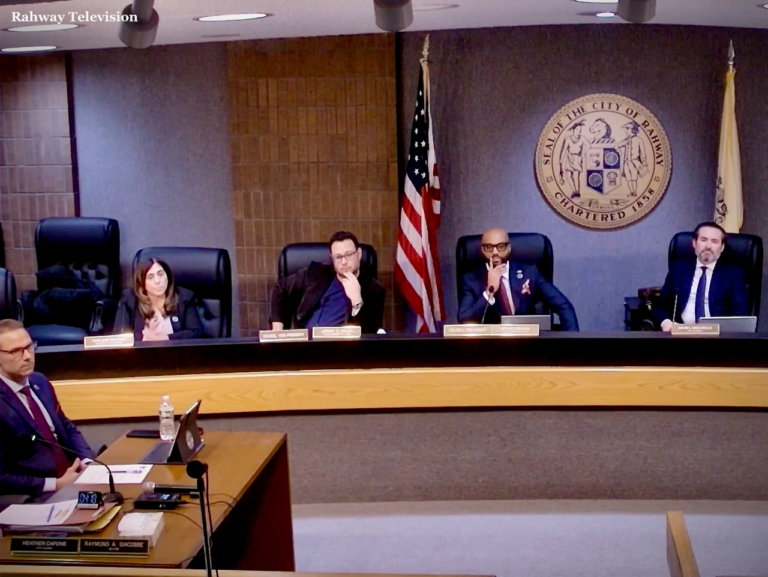
Rahway City Council members and Mayor Raymond Giacobbe during the March 3, 2026 council meeting where officials voted to cancel the bid process for the city’s water utility. (Rahway Television)
Chris Howell | March 3, 2026
The Rahway City Council voted Monday night to cancel the bid process for the city’s water utility, halting a potential privatization effort just one month after officials unanimously authorized the city to begin seeking buyers.
The resolution, approved as part of the council’s consent agenda, formally stops the process of soliciting bids for the Rahway Water Utility that had been scheduled for an April 1 bid opening. The move marks a sudden reversal in the city’s approach to the future of its municipal water system following weeks of public criticism and debate.
DON’T LET AN ALGORITHM DECIDE YOUR NEWS
Sign up for The Central Jerseyan Newsletter for independent hyperlocal news and events every Sunday.
Mayor Raymond Giacobbe told residents during the meeting that the decision came after additional discussions with council members and community stakeholders.
“Decisions of this magnitude must not be rushed,” the mayor said. “They must be made with full public understanding and trust.”
Pausing the process, he added, would create space for the city to fully understand “the financial, operational and long term impacts” while keeping “the long-term interest of Rahway at the center.”
The announcement also fulfilled a promise Giacobbe made during his State of the City address the previous week, when he said the administration would recommend the council cancel the bid solicitation process while the city re-evaluated its approach to the aging water system.
Although the vote cancels the immediate bid process, the mayor emphasized that the broader discussion about the future of Rahway’s water utility is not over.
“Canceling the receipt of bids does not end the conversation,” Giacobbe said.
The decision left many residents wondering what comes next.

Rahway Mayor Raymond Giacobbe speaks at the Union County Performing Arts Center during his 2026 State of the City address. (The Central Jerseyan)
During the public comment portion of the March meeting, several speakers pressed city leaders for clarity about next steps. Residents asked whether privatization was still under consideration and what alternative plans the city might pursue to address the system’s aging infrastructure.
Andrew Garcia Phillips, a Rahway resident who has been outspoken about the issue, questioned whether the council was exercising sufficient independent judgment. He noted that a council member had previously said he simply trusted the professionals when questioned about city policy.
“If you’re going to just defer to the professionals, why do we need you?” Garcia Phillips said. “We just hire some professionals. That’s why you’re here.”
Other speakers raised concerns about how the issue has been handled by the council, including criticism of an executive session held during last month’s meeting.
That closed-door session, called shortly before the council voted to seek bids for the water utility, drew scrutiny from some residents who argued the discussion should have taken place in public. During Monday’s meeting, Garcia Phillips and food and water advocacy organizer Charlie Kratovil both questioned whether the executive session complied with the state’s Open Public Meetings Act and asked council members to explain what was discussed behind closed doors.
City attorney David Minchello had indicated at the February meeting that the executive session was held to discuss contract negotiations. Garcia Phillips disputed that characterization at the March meeting, arguing that the discussion appeared instead to concern whether to proceed with the water resolution.
City officials did not address those concerns during the March meeting.
The uncertainty follows one of the most contentious council meetings in recent memory, when officials voted last month to begin seeking bids for the potential sale of the municipal water system.
During that February meeting, Giacobbe and outside consultants presented a detailed overview of the water utility’s finances and infrastructure needs. Consultants said much of the system dates back more than a century and warned that maintaining the utility could require significant upgrades in the coming years.
Michael Willis of T&M Associates told the council that the system carries roughly $30 to $32 million in existing debt and faces an estimated $33 million in capital improvements over the next decade. He presented a rate comparison showing that, under a private utility’s proposed rate structure, the average customer could save approximately $1,400 over 10 years compared to the city’s current projected rate trajectory — a difference he attributed primarily to the ability of a larger utility to spread infrastructure costs across a far bigger customer base.
City officials argued that selling the system to a larger private utility could help spread those costs across a broader customer base while still requiring any buyer to meet the same state and federal water quality standards.
But the proposal sparked strong opposition from residents and community advocates, who warned that privatization could ultimately lead to higher water rates and reduce local control over a critical public resource.
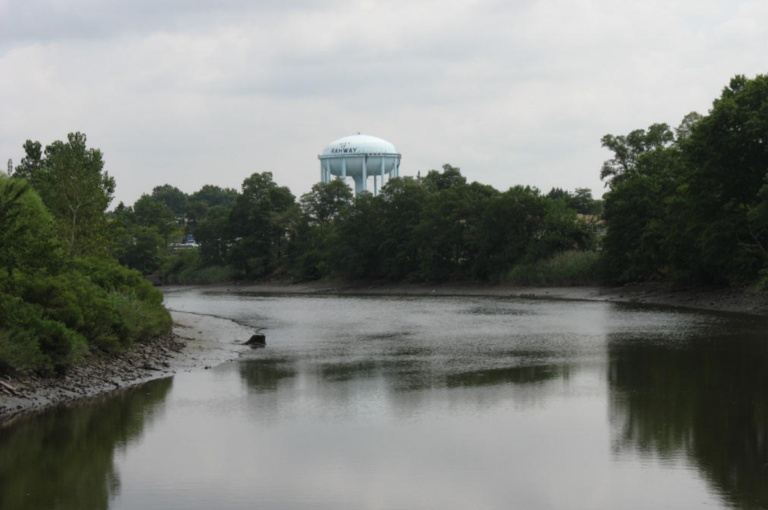
A view of the Rahway River with the city water tower rising above the tree line.
Rahway residents Jeff Robinson cautioned during the February council meeting that private water utilities operate as for-profit companies.
“Their first priority is to their stockholders and to making profit, not necessarily to the municipalities’ water facilities or the residents of those towns,” Robinson said.
Another speaker at the February meeting pointed to Gloucester Township, where voters rejected a proposal in November 2024 to sell the municipal water system to New Jersey American Water after months of public debate.
Despite those concerns, the Rahway City Council voted unanimously last month to authorize the bid solicitation process, a step that officials said would allow the city to evaluate potential offers before deciding whether to proceed with a sale.
Under state law, any agreement to sell the municipal water utility would ultimately require approval from Rahway voters through a public referendum.
For now, however, the city has paused the process entirely.
What comes next for Rahway’s water system remains unclear. City leaders said the decision to cancel the bid process is intended to allow additional review and discussion, but they did not outline a timeline for when — or if — the issue might return to the council agenda.
After months of heated debate and two dramatically different council votes just weeks apart, the future of Rahway’s water utility remains unsettled.
Editor’s note: The Central Jerseyan is free to read and supported by advertising. If you value this kind of local reporting and want to help sustain it, you can become a citizen supporter on Patreon. Your contribution helps fund continued coverage of local government, schools, and community issues.