Rahway Council Approves Bid Process for Water Utility After Heated Public Debate
Officials cite aging infrastructure and more than $30 million in debt, while residents warn privatization could raise long-term costs and reduce local control.
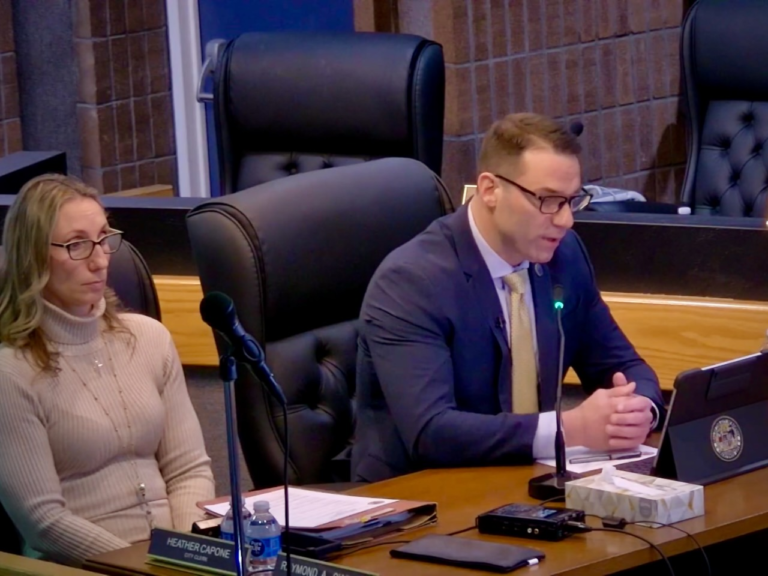
Rahway Mayor Raymond Giacobbe presents information on the city’s water utility during a City Council meeting at City Hall.
Chris Howell | February 3, 2026 (Last Updated: 12:30 PM)
The Rahway City Council unanimously approved a resolution Monday night to begin a formal bid process for the Rahway Water Utility, a move that could lead to a future municipal water sale. This decision followed hours of heated public debate where officials argued that water utility privatization is necessary to address aging infrastructure, while residents warned that selling the Rahway water system would lead to higher long-term rates and a loss of local control.
Although the vote advances the potential for water utility privatization, officials emphasized that it only authorizes the city to solicit and review proposals for the Rahway Water Utility, not a final sale. Any eventual agreement to sell the Rahway water system would still require a formal public referendum, ensuring that local voters have the final say before any transition of the city’s water services occurs.
City leaders and outside consultants framed the decision as a response to mounting financial and regulatory pressure tied to an aging system. During a presentation to the council, Michael Willis of T&M Associates said portions of Rahway’s water infrastructure date back to 1880, with much of the system now approaching the end of its useful life.
Willis told council members that the water utility currently carries more than $30 million in debt, a figure that became a focal point of the meeting after Councilwoman Dani Newbury asked directly how that debt factors into the city’s options.
DON’T LET AN ALGORITHM DECIDE YOUR NEWS
Independent hyperlocal news that’s fast, fair, and accurate.
Willis said the debt would remain with the city if Rahway kept the system and financed future upgrades itself. By contrast, he said, a sale would immediately retire the existing debt and shift responsibility for capital improvements to a regulated utility.
“That would be the first item paid off if there was a purchase and a sale,” Willis said.
According to Willis, engineering assessments project that maintaining and upgrading the system could cost roughly $33 million over the next decade. Spread across the city’s approximately 8,200 water customers, he said, that translates to about $1,400 per customer during that period if the city retains ownership.
Willis contrasted that scenario with privatization, arguing that a larger utility could distribute costs across a much broader customer base. Regulated water companies in New Jersey often serve tens or hundreds of thousands of customers, he said, reducing the financial burden placed on any single municipality.
Mayor Raymond Giacobbe told residents the city’s analysis has been underway for more than a year and includes engineering reviews, financial modeling, and comparisons with other communities that have faced similar decisions.
“Residents deserve clear, accurate information, and that is why this conversation is happening here tonight, in front of the public,” Giacobbe said during the meeting.
Public comment that followed was overwhelmingly critical. Numerous residents and advocates spoke against privatization, raising concerns about higher long-term costs, loss of local control, and the role of profit-driven utilities. No one from the public spoke in support of selling the system.

A presentation slide outlines the major components of the Rahway Water Utility, including treatment, storage, distribution, and intake infrastructure. (Source: T&M Associates)
Jeff Robinson, a Rahway resident and former president of the Rahway Environmental Commission, questioned why the commission had not been included earlier in the city’s review process.
“Never once was it ever brought to the attention of the Environmental Commission, maybe to ask for our input,” Robinson said, urging the council to slow the process and broaden public engagement before advancing toward a referendum.
Robinson and others warned that private utilities ultimately answer to shareholders, not residents.
“These companies that run water facilities are for-profit companies,” Robinson said. “Their first priority is to their stockholders and to making a profit, not necessarily to the municipalities’ water facilities or the residents of those towns.”
Several speakers challenged the idea that privatization would deliver lasting savings, noting that rate-stabilization periods can expire, leaving customers exposed to higher bills. One resident cited a 2022 Cornell University study identifying private ownership as the single largest factor associated with higher water costs.
Others pointed to recent examples in New Jersey. Robinson urged council members to look at Gloucester Township, where voters rejected a proposal in November 2024 to sell the municipal water system to New Jersey American Water after months of public debate.
Residents and advocates also raised concerns that privatization introduces financial pressure tied to corporate profit expectations, potentially shifting costs onto consumers over time.
In response, Bob Landolfi, the mayor’s chief of staff, said that any private operator would still be subject to the same regulatory oversight as the city. He added that a buyer could potentially achieve efficiencies by choosing not to continue operating Rahway’s existing treatment plant and instead supplying water from other sources.
“What we have is a free-flowing source of water that is at the bottom of a heavily populated area that has huge potential for contaminants to enter into that system, making it very difficult, expensive, and problematic to treat,” Landolfi said.
The vote itself included a brief but notable turn late in the meeting.
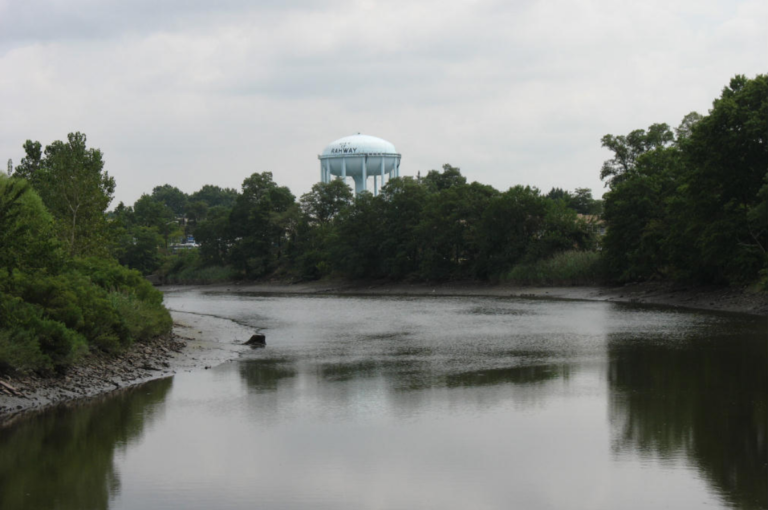
A view of the Rahway River with the city water tower rising above the tree line. The image illustrates reporting on the Rahway City Council’s consideration of a bid process that could lead to the sale of the city’s public water utility. (Photo Source)
After questioning consultants and listening to public comment, Councilwoman Joanna Miles said she planned to vote against the resolution, citing a desire for more time to research the proposal before advancing the process.
Council President Jeffrey Brooks then proposed that the council enter an executive session. The council recessed briefly and returned to the dais a short time later.
When the meeting resumed, Miles said she had reconsidered and would vote in favor of the resolution.
“You can have more information, information about what’s in it for Rahway, what do the bids look like?” Miles said. “So that really clarifies things for me.”
The council then voted unanimously to approve the measure as part of the consent agenda, which allows the council to pass multiple resolutions in one vote.
The resolution approved Monday authorizes the mayor and business administrator to prepare and advertise bid specifications and solicit proposals from regulated utilities. It allows the city to reject any or all bids and makes clear that no sale could proceed without voter approval.
For now, the vote marks the start of a prolonged public debate. City officials say selling the utility could eliminate debt and reduce long-term financial risk. At the same time, many residents remain unconvinced that those benefits outweigh the loss of local control over Rahway’s water supply.
Editor’s note: The Central Jerseyan is free to read and supported by advertising. If you value this kind of local reporting and want to help sustain it, you can become a citizen supporter on Patreon. Your contribution helps fund continued coverage of local government, schools, and community issues.